Day 1 — Arrival in Arusha & Tarangire National Park
Route: Arusha/KIA → Tarangire National Park Drive Time: Approximately 2 hours Overnight: Tarangire
Your journey begins in Arusha, Tanzania’s safari capital, where your driver-guide will meet you at the airport or your hotel and introduce you to what lies ahead. After a briefing and vehicle check, you head south toward Tarangire National Park for your first afternoon game drive.
Tarangire is the perfect opening chapter — its riverine landscape, ancient baobab trees, and spectacular elephant herds ease you gently into the rhythm of safari life without overwhelming the senses all at once. During the dry season, the Tarangire River becomes a lifeline for wildlife across the region, drawing elephants in family groups of twenty, thirty, even fifty individuals to drink and bathe along its banks.
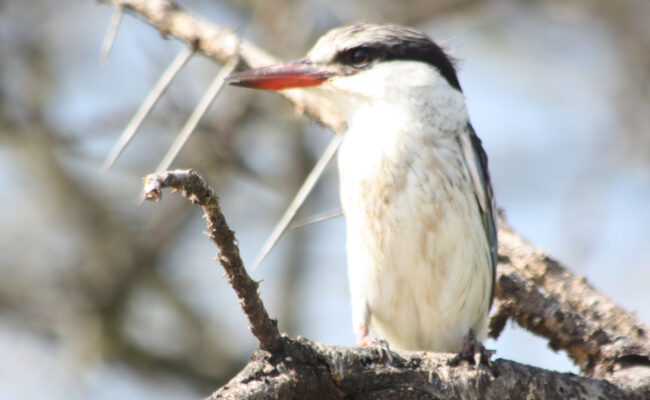
The park’s birdlife is equally remarkable — over 550 species recorded here, including the yellow-collared lovebird, the ashy starling (found almost nowhere else in the world), and the iconic lilac-breasted roller catching the afternoon light.
Dinner at camp as the bush settles into its nighttime soundtrack around you — a perfect first evening in Tanzania.
Wildlife to look out for: Elephant herds, giraffe, buffalo, zebra, greater kudu, gerenuk, impala, warthog, and exceptional birdlife.
Day 2 — Full Day in Tarangire
Route: Tarangire National Park (full day) (10-day version only) Overnight: Tarangire
A full day in Tarangire rewards you with the kind of unhurried safari experience that shorter itineraries can’t afford. You’ll depart your camp before sunrise for a morning drive through the river valley — the best time to find predators returning from a night’s hunt and elephants gathering at the water.
The Silale Swamp in the park’s south is one of East Africa’s most productive wildlife-viewing areas and worth the longer drive to reach it. Buffalo herds number in the hundreds here. Eland, Tanzania’s largest antelope, move in quiet columns through the surrounding woodland.
Afternoon brings a drive into the baobab country that makes Tarangire visually unlike any other Tanzanian park — a landscape that feels ancient, even prehistoric, in the best possible way.
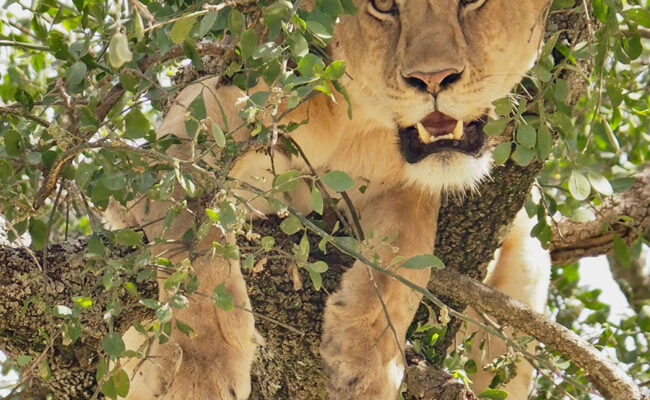
Wildlife to look out for: Lion, leopard (less commonly seen but present), large elephant aggregations at the river, buffalo herds, tree-climbing pythons (in the baobab branches — ask your guide), and superb birdlife including hornbills, bee-eaters, and raptors.
Day 3 — Tarangire to Ngorongoro Conservation Area
Route: Tarangire → Karatu → Ngorongoro Crater Rim Drive Time: Approximately 3–4 hours Overnight: Ngorongoro Crater Rim
After a final morning drive in Tarangire, you begin the drive northward through the small highland town of Karatu and into the elevated landscapes of the Ngorongoro Conservation Area. The road climbs steadily through coffee and banana farms, Maasai grazing lands, and montane forest before arriving at the crater rim — sitting at around 2,400 meters, cool, misty, and dramatic.
The first view of the Ngorongoro Crater from the rim is a moment that stops most travelers cold. A collapsed volcanic caldera 20 kilometers across and 600 meters deep, it looks from the edge like a world set inside a world — green and golden on the floor below, ringed by steep walls cloaked in forest. It was formed roughly two to three million years ago, and it has been sheltering life ever since.
Tonight you sleep on the rim, wrapped in highland air and the sound of wind through the montane trees. The temperature drops significantly after dark — a reminder that Tanzania offers more than heat and dust.
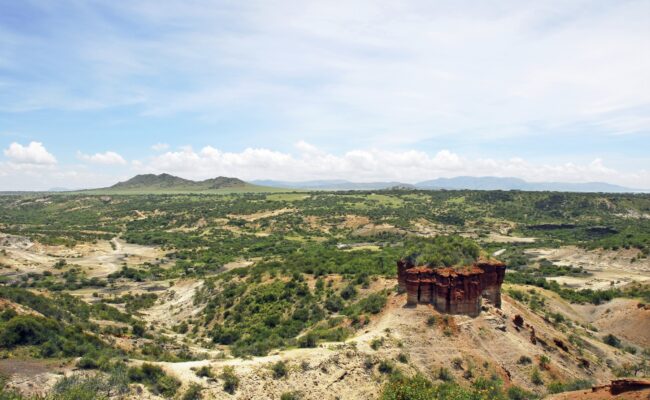
En route stop: Olduvai Gorge (Oldupai) — one of the most important archaeological sites in the world, where fossils and tools have helped establish this part of East Africa as central to the story of human evolution. A brief guided visit with the on-site museum is included.
Day 4 — Ngorongoro Crater Floor
Route: Crater rim → Crater floor → Crater rim Descent: Early morning Overnight: Ngorongoro Crater Rim or Serengeti (depending on preference)
An early rise and a steep, winding descent into the crater floor, reaching the bottom as morning mist still hangs above the grasslands. The experience inside the crater is distinct from anywhere else in Tanzania — wildlife here is less mobile than in the open Serengeti, and animals have become accustomed to vehicles, allowing remarkably close and calm encounters.
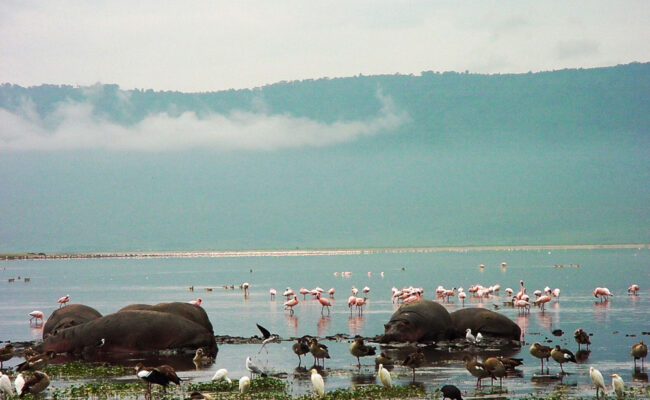
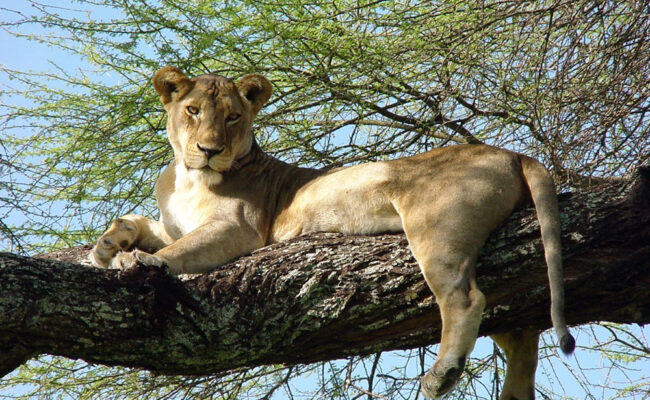
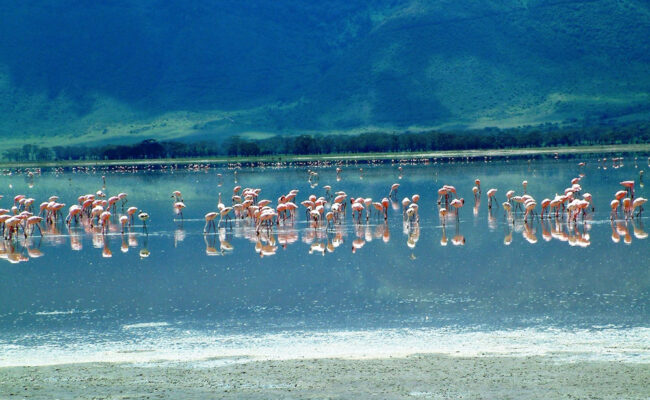
The crater floor offers a concentrated ecosystem: the shallow Lake Magadi draws flamingos in pink-fringed hundreds; hippo wallow in the freshwater pools of the Gorigor Swamp; black rhino — one of Africa’s most endangered mammals — graze the short grasses in the early morning. Lion prides are a near-daily sighting, often lying in full view on the open plains. Spotted hyena clans, golden jackals, and silver-backed jackals move through the grasslands with purpose.
Your guide will spend three to four hours on the crater floor before ascending the wall again, where the views back down are just as striking as the descent. Lunch is taken at the picnic site on the crater rim.
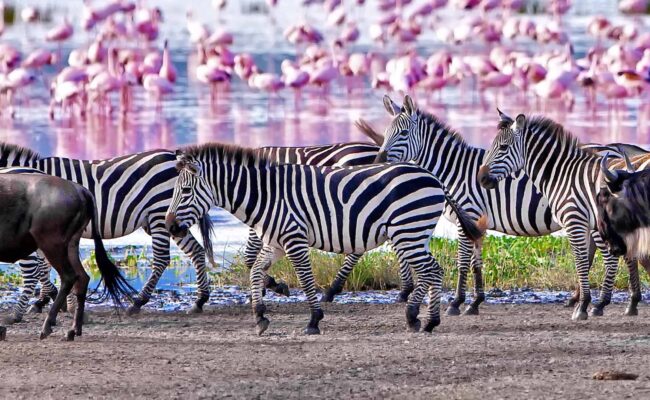
Wildlife to look out for: Black rhino (rare and precious), lion, spotted hyena, golden jackal, elephant bull (bulls descend alone; family groups rarely enter the crater), hippo, flamingo, zebra, wildebeest, and the remarkable Ngorongoro hartebeest.
Day 5 — Ngorongoro to Serengeti National Park
Route: Ngorongoro → Serengeti (Seronera Valley or as per season) Drive Time: Approximately 2–3 hours to Naabi Hill Gate Overnight: Serengeti
The drive west from Ngorongoro into the Serengeti crosses the short-grass plains of the Ngorongoro-Serengeti ecosystem — a vast, treeless expanse where the wildebeest calving season plays out each year between December and February, and where cheetah are frequently spotted hunting in open ground with nowhere to hide.
Passing through the Naabi Hill Gate, you enter the Serengeti officially and the landscape opens in every direction. “Endless plains” is not a poetic exaggeration — it is a straightforward description of what you are looking at. The Serengeti covers nearly 15,000 square kilometers, making it larger than some countries, and it holds one of the densest concentrations of large mammals anywhere on the planet.
Your camp in the Seronera area positions you in the wildlife-rich corridor of the central Serengeti, where year-round water in the Seronera River attracts predators, prey, and the most rewarding game-viewing outside of the migration spectacle itself. Afternoon game drive on arrival.
Wildlife to look out for: Cheetah on the open plains (some of the best cheetah viewing in Africa), lion, leopard along the riverine trees of the Seronera River, hippo, crocodile, topi, Thomson’s and Grant’s gazelle.
Day 6 — Full Day in the Serengeti
Route: Serengeti National Park (full day) Overnight: Serengeti
Your final full day on safari. Make the most of it. You’ll leave camp before the sun rises and spend the full day in the field, with your guide tracking whatever the park has in store — lion on a kill from the night before, cheetah cubs playing in the long grass, a leopard draped over an acacia branch with prey hoisted into the branches above.
The Serengeti rewards patience and presence above all else. There is no shortcut to its best moments, and no algorithm for when they will arrive. But they will arrive — and when they do, the memory settles in somewhere permanent.
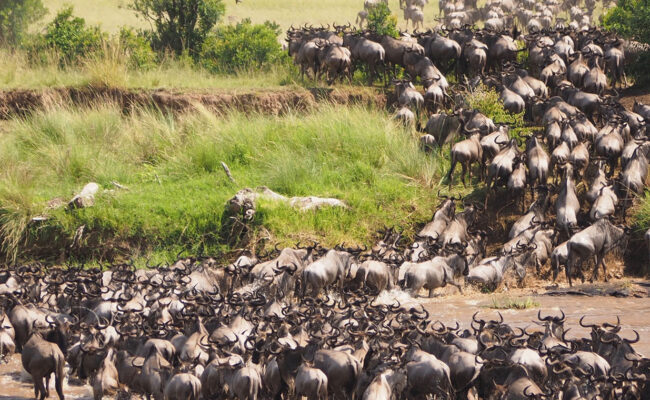
Depending on the time of year, your guide may take you toward the migration columns if they are moving through the central or northern corridor. Or the morning might be devoted to a specific predator sighting that comes through on the radio network. By mid-morning you’ll have a sense of the day’s story; by sunset you’ll have a chapter you’ll be telling for years.
Optional add-on: Hot air balloon safari over the Serengeti at dawn, floating above the plains as the sun rises and the animals below resume their morning routines. Champagne bush breakfast upon landing. One of the most spectacular experiences in African travel — ask us about availability when booking.
Wildlife to look out for: Whatever the Serengeti decides to offer — and it is rarely disappointing.
Day 7 — Serengeti to Zanzibar (by light aircraft)
Route: Serengeti airstrip → Zanzibar International Airport (via scheduled light aircraft) Flight Time: Approximately 1.5–2 hours (may include a stop at Arusha) Overnight: Zanzibar — your beach resort
This is the transition day — and it is a remarkable one. You board a small aircraft at a bush airstrip, possibly still dusting the Serengeti from your boots, and by early afternoon you are descending toward a glittering blue coastline, coral sand, and the warm humidity of the Indian Ocean.
Zanzibar — officially Unguja Island — is the largest island in the Tanzanian archipelago and one of the most storied destinations in the western Indian Ocean. Its position along ancient trade routes made it a meeting point for African, Arab, Persian, Indian, and later European cultures over many centuries. The result is an island with extraordinary cultural and culinary depth, a UNESCO-listed historic center, and some of East Africa’s most beautiful beaches.
Your transfer from Zanzibar International Airport to your beach resort takes between 45 minutes and 1.5 hours depending on the location you have chosen. Check-in, change into something lighter, and spend the remainder of the afternoon simply existing beside the ocean.
There is genuinely nothing you need to do today except arrive.
Day 8 — Stone Town & Spice Tour
Route: Beach Resort → Stone Town → Spice Plantation → Beach Resort Overnight: Zanzibar
Stone Town is the historic heart of Zanzibar City and one of the finest examples of Swahili coastal architecture in the world. Its narrow, labyrinthine alleyways open unexpectedly onto ornate mosques, carved wooden doorways studded with brass, colonial-era buildings in various states of magnificent decay, and small squares where old men play bao and traders call out their wares.
Your guided morning in Stone Town will take in the main landmarks: the old Arab Fort, the Palace Museum (Beit el-Sahel), the House of Wonders, the slave memorial and underground chambers at the Anglican Cathedral — a sobering and essential reminder of the island’s complex history as the center of the East African slave trade — and the famous Forodhani Gardens waterfront, where the evening food market draws locals and visitors alike.
Afternoon brings the spice tour — a visit to a working plantation where cloves, nutmeg, cinnamon, vanilla, cardamom, black pepper, and ylang-ylang are grown among banana palms and breadfruit trees. Your guide will find, identify, smell, and taste each spice with you, explaining its history and culinary use. It’s a relaxed, sensory experience that leaves most travelers with a much richer understanding of why Zanzibar was once the world’s largest clove producer and one of the most coveted trading ports in the Indian Ocean.
Return to your resort by late afternoon for a sunset on the beach.
Cultural note: Stone Town is a living Muslim community. Modest dress (covered shoulders and knees) is appreciated and respectful when visiting the town, particularly around mosques and the market.
Day 9 — Reef, Water, and Pure Beach
Route: Beach Resort and surrounding waters Overnight: Zanzibar
Today belongs entirely to the ocean. Zanzibar sits on one of the largest coral reef systems in the western Indian Ocean, and the snorkeling and diving opportunities around the island are genuinely world-class.
Your options today depend on what calls to you:
Snorkeling at Mnemba Atoll — Just off the northeast coast, Mnemba Atoll is one of East Africa’s finest snorkeling and diving sites, with excellent visibility, vibrant coral, reef fish in extraordinary variety, green turtles, and occasional dolphin. A half-day boat trip with guide and equipment is easily arranged.
Scuba Diving — Zanzibar’s waters support several excellent dive sites for certified divers, from shallow reef walls to more advanced sites. Your resort or our concierge can connect you with reputable local dive operators.
Dolphin Tour at Kizimkazi — The fishing village of Kizimkazi on the island’s southern tip is a departure point for dolphin-watching and swimming tours. Spinner and bottlenose dolphins are regularly spotted in these waters.
Do Nothing — An equally valid option. Your resort beach is yours. A book, a sun lounger, the sound of the Indian Ocean, and a mango juice from the bar is a complete and legitimate day’s itinerary.
By evening, whether sunburned from the reef or pleasantly sun-drenched from the beach, you’ll have what you came for — the deep, uncomplicated rest that follows a week of extraordinary experience.
Sunset recommendation: Kendwa Rocks or Nungwi Beach in the north offer spectacular west-facing sunsets directly over the ocean — some of the best in East Africa.
Day 10 — Leisure Morning & Departure
Route: Beach Resort → Zanzibar International Airport Departure: Afternoon or evening flight
Your final morning on the island. Depending on your flight time, you may have a full morning to spend on the beach, take a final swim in the Indian Ocean, or explore the resort grounds before your transfer to the airport.
Zanzibar International Airport (Abeid Amani Karume International Airport) handles both domestic connections and an increasing number of international flights. Your departure point home, or to wherever Tanzania’s call has pointed you next.
Accommodation Options
Safari Nights
Standard (Comfortable Lodge) Clean, comfortable accommodation with en-suite facilities, reliable hot water, and full board. Solid wildlife positions and friendly service. Example properties: Tarangire Safari Lodge, Ngorongoro Sopa Lodge, Seronera Wildlife Lodge
Mid-Range (Elevated Comfort) Boutique camps and lodges with thoughtful design, better park positioning, more personalized service, and elevated dining. Example properties: Lemala Mpingo Ridge (Ngorongoro), Kubu Kubu Tented Lodge (Serengeti), Neptune Ngorongoro Luxury Lodge
Luxury (Premium Safari) Intimate, high-end camps with exceptional service, gourmet food, premium bar, and private guide access. Example properties: Asilia Namiri Plains (Serengeti), &Beyond Ngorongoro Crater Lodge, Sanctuary Swala (Tarangire)
Zanzibar Nights
Standard (Comfortable Beach Hotel) Well-located beach hotels with pool, restaurant, and direct beach access. Good value for the Zanzibar experience. Example properties: Doubletree by Hilton Nungwi, White Sand Luxury Villas & Spa (budget tier)
Mid-Range (Boutique Beach Resort) Stylish, smaller properties with personalized service, beachfront positioning, and design that reflects the island’s Swahili-Indian Ocean aesthetic. Example properties: Essque Zalu Zanzibar, Zanzibar White Sand Luxury Villas, Matemwe Lodge
Luxury (Premium Beachfront) Exclusive resorts with private pools, butler service, overwater or beachfront villas, and the kind of setting where every photograph looks like a magazine cover. Example properties: The Residence Zanzibar, Baraza Resort & Spa, Zuri Zanzibar
 English
 Dutch
Dutch Japanese
 Korean
 Chinese

 Support info@manyangatours.com